
 English
 中文简体
 عربى
 Español

Introduction to LED Ceiling Lights LED ceiling lights have become a popular choice for modern homes,...
Content
- 1 What Actually Makes a Bathroom Mirror "Backlit"?
- 2 Why the Mirror on Its Own Is Rarely Enough
- 3 Matching Colour Temperature to the Mirror's Backlight
- 4 Placement and Installation: The Details That Decide the Result
- 5 Moisture, Safety and the Things That Age Well
- 6 Choosing the Mirror and the Lighting as One Set
- 7 Working With a Manufacturer on Bathroom Lighting
Backlit bathroom mirrors have a way of making a room feel finished. The soft halo behind the glass turns an ordinary wall into a focal point, adds depth to a small bathroom, and gives you a gentle glow for a three in the morning visit that will not blind you. We manufacture LED luminaires — downlights, spotlights, bulbs, batten lights and wall lights — and we talk to bathroom brands, importers and installers every week. The question we hear most often is not whether a backlit mirror is worth buying, but how to light everything around it so the mirror looks as though it was always meant to be there. That is what this guide sets out to answer.
What Actually Makes a Bathroom Mirror "Backlit"?
A backlit mirror is a simple idea. An LED strip is fixed behind the glass, normally running around the inner edge of the frame. A frosted border on the glass, or a slim diffuser placed in front of the diodes, spreads the light so you see an even band of illumination rather than a string of dots. Light escapes around the edge of the mirror and washes the wall behind it, which is the effect people recognise as the floating mirror.
The result is more useful than it sounds:
- The wall behind the mirror becomes part of the design, so the glass stops sitting flat on the surface.
- Light arrives from the sides rather than straight down, which fills a room more evenly than one ceiling fitting.
- Dimmed down low, the backlight becomes a comfortable night light for the bathroom.
What a backlit mirror does not do is light your face. That job still belongs to the rest of the lighting, and it is where many bathroom projects go slightly wrong.
Why the Mirror on Its Own Is Rarely Enough
Almost all of a backlit mirror's output travels sideways and upwards, away from the person standing at the basin. If it is the only light in the room, faces fall into shadow and the bathroom feels dimmer than the showroom photographs suggest.
Light for the face
You want light in front of the person, at roughly eye level. Two wall lights placed either side of the mirror, something like 600 to 800 mm apart and at about head height, are the classic answer because they throw light onto the face from both sides and soften shadows under the eyes and nose. Downlights mounted in the ceiling directly above the spot where somebody stands do the opposite: they drop shadows downwards and make shaving or applying make-up harder than it needs to be.
Light for the rest of the room
Ceiling downlights and a central fitting carry the everyday load: shower, bath, floor, towels, the whole space. In a bathroom those fittings have to be chosen with water in mind, which is why an IP65-rated downlight is a sensible default for the areas close to a shower or bath.
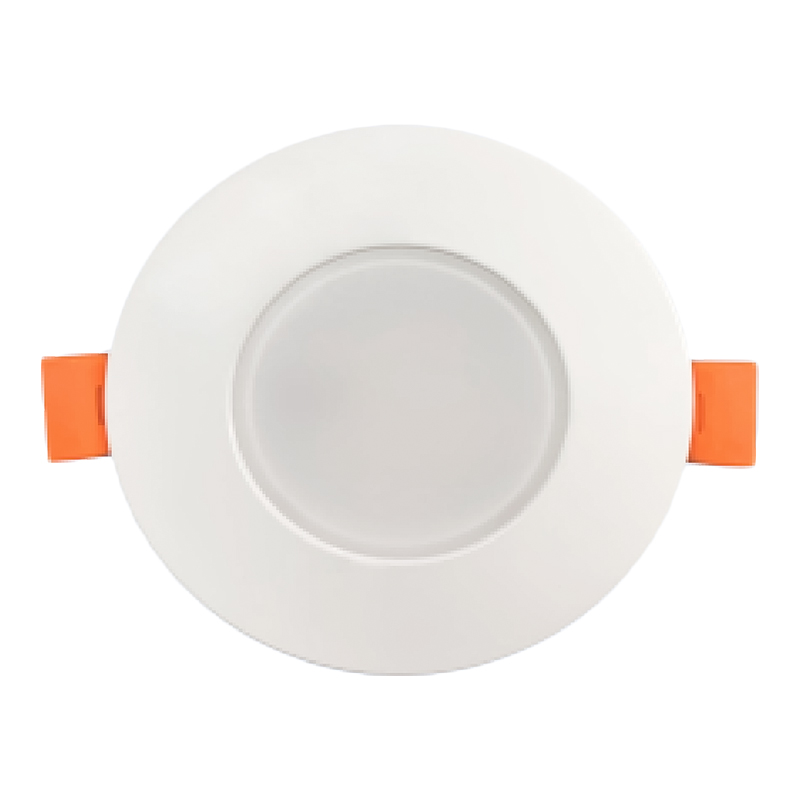 IP65 3CCT Available LED Downlight 5W/7W–IP65-DL-5W-CCT (5W, 560LM)View Product →
That model is a good illustration of the approach: a sealed, IP65-rated 5W or 7W downlight with selectable colour temperature, so the same fitting can be set close to the warm tone of the mirror backlight or to a crisper neutral for the rest of the room.
Matching Colour Temperature to the Mirror's Backlight
Colour temperature is the most common source of disappointment in a bathroom. Choose a mirror with a warm backlight, fill the ceiling with cool white downlights, and the room looks as though two different bathrooms were photographed side by side. The table below is the reference we use when helping customers put a lighting package together.
| Colour temperature | How it reads | Works well for | Watch out for |
|---|---|---|---|
| 2700K | Warm and amber, close to candlelight | Evening bathrooms, spa-style schemes, bathing areas used mostly at night | Can look yellow against grey or white stone |
| 3000K | Soft warm white, the tone most people picture when they say hotel bathroom | Everyday family bathrooms and the usual default for mirror backlights | Warmer than many standard cool white lamps, so check the rest of the room matches |
| 4000K | Clean neutral white, crisp without turning blue | Grooming zones, make-up, bathrooms with white tiles and chrome | The room can start to feel clinical late in the evening |
| 5000K to 6000K | Daylight, very bright and very crisp | Utility areas and mirrors where colour accuracy matters most | In a small bathroom the effect is often harsh and skin looks pale |
A practical rule we give customers: keep the mirror backlight and the room lighting within roughly 500K of each other. If the mirror sits at 3000K, choose 3000K or 3500K elsewhere. If grooming needs a crisper look, a 4000K mirror with 4000K downlights stays consistent, though the room will feel cooler overall.
Placement and Installation: The Details That Decide the Result
Most of the complaints we hear after a bathroom refresh trace back to a handful of measurements and choices. These are the ones worth getting right before the tiles go on:
- Mirror height: the centre of the mirror around 1.1 to 1.2 m from the floor, or roughly 200 mm above the tap, so you see your whole head and shoulders while standing.
- Wall light height: at eye level, one on each side of the mirror, 600 to 800 mm apart. Avoid mounting a light directly above the mirror if the ceiling is low, as it will shine into your eyes.
- Zones and IP ratings: IP44 or higher in zone 2 and IP65 close to the shower or bath, where spray is likely.
- Dimming: check that the mirror's driver is dimmable and that it suits the dimmer type in use. TRIAC dimming remains the usual choice in residential projects, and not every backlight dims at all.
- Separate switching: put the backlight, the wall lights and the main ceiling lighting on separate circuits so you can use only what the moment needs.
- Driver access: make sure the driver behind the mirror can be reached for servicing without breaking tiles.
Adjustable output helps here too. A wattage-selectable downlight lets the installer set the real light level on site, which is useful when ceiling height, tile colour or the number of fittings changes between the drawing and the finished room.
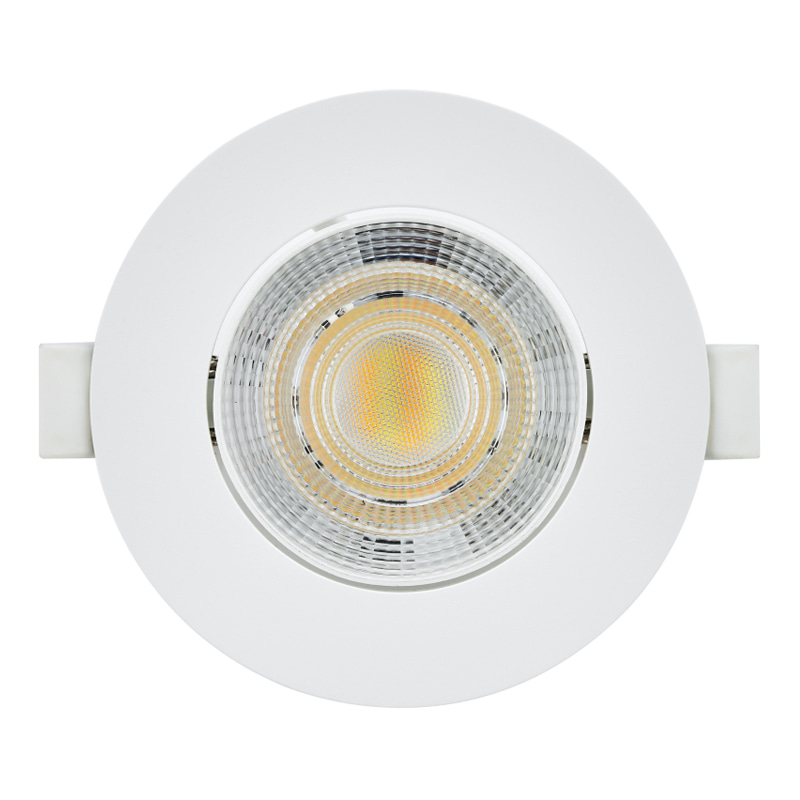 3CCT and Wattage Selectable Recessed LED DownlightSet 3W, 5W, or 7W output and 3000K, 4000K, or 6500K light on site, with anti-glare optic and spring-clip installation for commercial or residential ceilings.View Product →
Moisture, Safety and the Things That Age Well
Bathrooms are hard on fittings. Humidity swings, cleaning sprays and warm air all take their toll, and a mirror's backlight is only as reliable as the driver hidden behind it. Over five or ten years, what matters is unglamorous: sealed diffusers, proper gaskets, corrosion-resistant finishes, and drivers with sensible thermal design rather than the cheapest possible components.
When you compare options, look for a declared IP rating rather than wording such as suitable for bathroom use, and ask what happens if a driver fails. Our own range is built around sealed optics, standardised drivers and finishes that survive a damp room, and our factory works to an ISO 9001 quality system covering incoming materials, production and final inspection.
Choosing the Mirror and the Lighting as One Set
When customers ask us to quote for a bathroom project, we usually suggest deciding these points together rather than one at a time:
- Colour rendering: lamps at CRI 90 or above show skin tones and tile colours more faithfully, which matters most around a mirror.
- Size: the mirror is usually around 60 to 80 per cent of the vanity width, which leaves room for wall lights either side without crowding.
- Dimming: if the backlight dims, the wall lights should dim too, on the same dimmer or a compatible one.
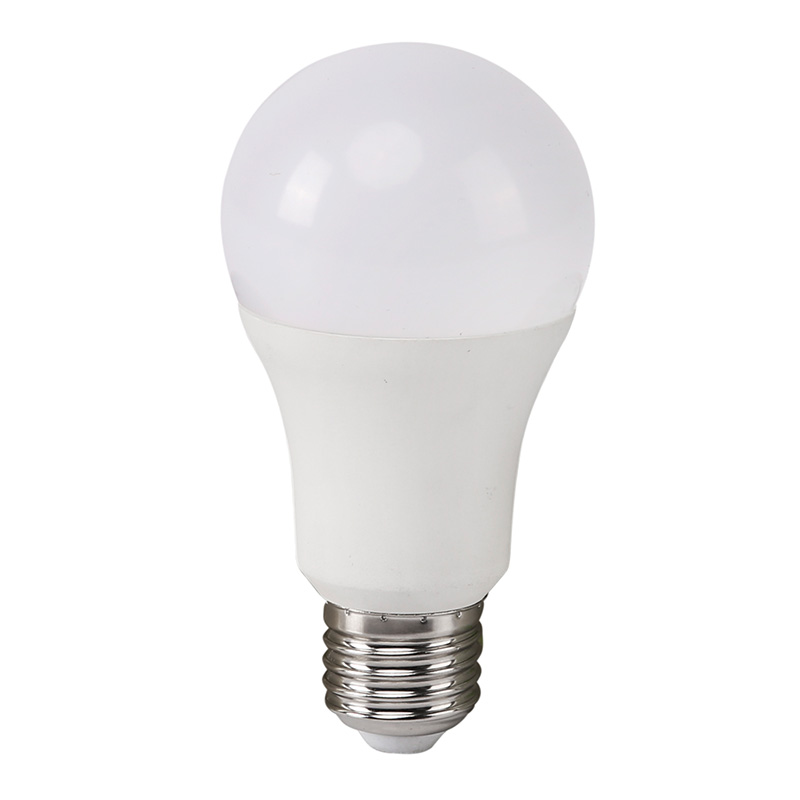
- Lamp type: retrofit wall lights with E14 or E27 bases are easy to match, and a TRIAC dimmable lamp keeps behaviour consistent with the mirror.
 TRIAC Dimmable LED Bulbs for Wholesale and OEM SupplyCompare 7W–15W E26/E27 bulbs with 10–100% TRIAC dimming, CRI >80, and 100–277V input for residential, hospitality, or retail lighting.View Product →
If you are still working out how many downlights the ceiling needs and where they should sit, our guide on choosing and installing LED downlights walks through spacing, layout and the mistakes worth avoiding.
Working With a Manufacturer on Bathroom Lighting
We are a lighting manufacturer based in Cixi, Zhejiang, and we have been exporting LED luminaires for more than thirteen years to customers in Europe, the Americas and Asia-Pacific. Much of that work is OEM and ODM: a brand or importer brings a blueprint, a sample or simply a specification, and our team develops the fitting around it. Our product lines cover downlights, spotlights, bulbs, batten lights and ceiling lights, which is convenient when a bathroom project needs several fixture types that share the same colour temperature and finish.
If you are putting together a bathroom range and want a supplier who can talk through the lighting design as well as the paperwork, get in touch with our team and tell us what you are planning.
A backlit mirror is one of the few bathroom purchases that improves a room both day and night, and it deserves better than being treated as a last-minute addition. Decide on the colour temperature first, give the face good light from the sides, keep the room lighting consistent, and the whole space will feel calmer, brighter and much easier to live with for years.
